
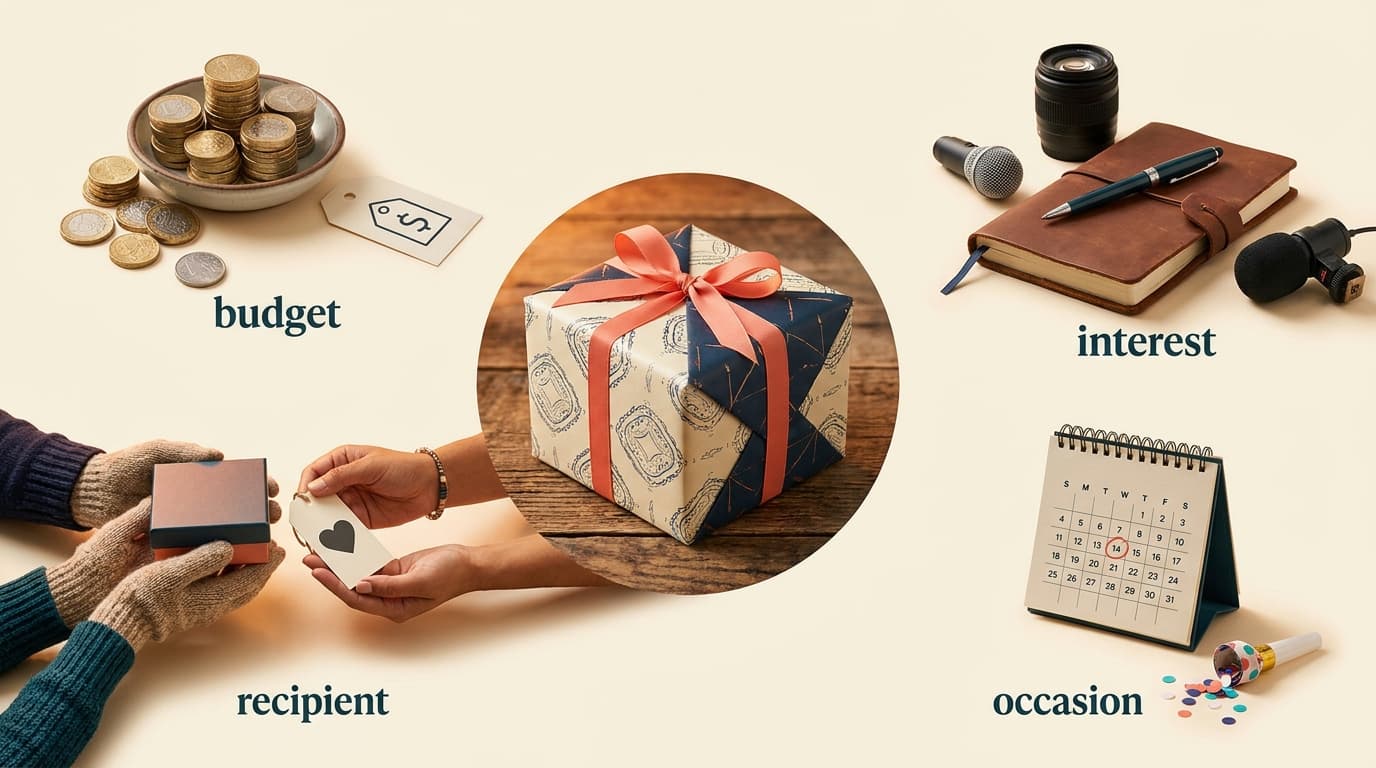
"Gift guide" is one label for at least four very different formats, and picking the wrong one is why most guides fall flat. A guide built around a recipient ("for the new parent") works nothing like one built around a budget ("everything under $25") or an occasion ("housewarming gifts"). Each type answers a different shopper question, and the type you choose decides who clicks, what they buy, and whether your guide gets shared.
This guide breaks down every common type, when each one wins, and how to pick the right format before you curate a single item. It is a companion to our pillar on how to build a gift guide people can browse.
What are the different types of gift guides?
There are four main types of gift guides, organized by the axis the shopper filters on: by recipient (who the gift is for), by budget (how much they want to spend), by occasion (the event driving the purchase), and by interest or theme (a shared hobby or aesthetic). Most published guides are one of these four, and the strongest pick a single axis instead of mixing them. The reason matters: a gift shopper arrives with one dominant question, and your guide should answer exactly that question. Curation guides such as Craft Industry Alliance recommend a tight set of 7 to 15 items per guide, which only works when one clear axis keeps the list focused. A "gifts for everyone" page has no axis, so it gives a browser no reason to trust the picks.
| Type | Filters by | Example title | Best for |
|---|---|---|---|
| Recipient | Who it's for | "Gifts for the Home Baker" | Broad audiences, family shoppers |
| Budget | Price ceiling | "Thoughtful Gifts Under $25" | Deal seekers, last-minute buyers |
| Occasion | The event | "Housewarming Gifts They'll Use" | Time-bound, seasonal traffic |
| Interest / theme | A hobby or aesthetic | "For the Cozy Night-In Crowd" | Creators, niche communities |
Gift guide by recipient: who the gift is for
A recipient gift guide is organized around the person receiving the gift, such as "gifts for him," "for the new parent," or "for your coffee-obsessed coworker." It is the most common and most intuitive type, because gift shoppers almost always start from a person, not a product. The mechanism is empathy: when a guide names the recipient precisely, the shopper trusts that you understand that person's taste. Specificity is the lever. "Gifts for Dad" is weak because every dad is different, while "Gifts for the Dad Who Already Has Every Tool" signals real insight and earns the click. Retail editorial leaders like NYT Wirecutter and NYMag's The Strategist build most of their seasonal traffic on recipient guides for this reason. Use this type when your audience shops for other people, and tighten the recipient until the title reads like one shopper's exact question.
When you build a recipient guide, group the items into 3 to 5 sub-personas if the audience is broad ("for the practical dad," "for the hobbyist dad"). That keeps a wide guide scannable without losing the personal feel that makes recipient guides convert.
Gift guide by budget: how much they want to spend
A budget gift guide is organized around a price ceiling or set of price tiers, such as "gifts under $25," "under $50," or a tiered "$, $$, $$$" layout. It works because budget is the single hardest constraint most gift shoppers carry into a purchase, so a guide that filters by price removes their biggest source of friction first. Shopify's own merchandising guidance recommends presenting price as ranges or symbols ($, $$, $$$) rather than exact figures, because exact prices go stale the moment a retailer runs a sale. A budget guide leans into that: instead of hiding price, it makes price the headline. This type performs especially well for last-minute and deal-driven shoppers, and around high-traffic windows like Black Friday. Use budget guides when your audience is price-sensitive, and label each tier clearly so a shopper can jump straight to their band.
Practical bands that scan well:
- Stocking stuffers: under $15
- The reliable gift: $25 to $50
- The splurge: $100 and up
Keep exact prices out of static guides. They age badly. A live page that pulls current prices is the exception, since it self-updates.
Gift guide by occasion: the event driving the purchase
An occasion gift guide is organized around the event prompting the purchase, such as a housewarming, wedding, baby shower, graduation, or a specific holiday. It works because the occasion sets the rules: a housewarming gift, a hostess gift, and a milestone birthday gift each carry different expectations for tone, price, and appropriateness. The occasion does the filtering that a shopper would otherwise have to do in their head. This type also has the strongest freshness and seasonality signal, since searches for occasion guides spike predictably (holiday queries climb from October, wedding-season guides peak in spring). That makes occasion guides the easiest to time for search traffic. Use this type when you can map your picks to a clear, recurring event, and publish or refresh it ahead of the seasonal spike rather than during it. Name the occasion in the title so both shoppers and search engines know exactly what moment you are serving.
Occasion guides pair naturally with a recipient or budget angle ("wedding gifts under $75"), which sharpens them further without breaking the single-axis rule.
Themed and interest-based gift guides
A themed or interest-based gift guide is organized around a shared hobby, aesthetic, or lifestyle rather than a person or price, such as "for the cozy night-in crowd," "for the home barista," or "sustainable gifts for the eco-conscious." This is the type creators and niche brands win with, because it speaks to identity: a shopper who sees their tribe named ("for the trail runner") trusts a curator who clearly belongs to it. The mechanism is point of view. Where recipient and budget guides are functional, themed guides sell taste, and taste is exactly what an audience follows a creator for. They also resist commoditization, since "gifts for the ceramics obsessive" cannot be copied by a generic retailer the way "gifts under $25" can. Use this type when you have genuine authority in a niche or a distinct aesthetic, and let your real first-hand experience with the items carry the guide.
Here is a live, browsable example of a themed gift guide built as a Shelfy collection. Notice how it groups items into clear sections, shows an image for every pick, and stays tappable on a phone.
Because it is a live page rather than a static export, you can reorder picks, swap anything that sells out, and share the whole guide with one link. For ready-made starting points across all four types, see our gift guide templates and examples that convert.
How do you choose which type of gift guide to make?
Choose your gift guide type by starting from the one question your audience is most likely asking, then matching it to the axis that answers it: a person leads to a recipient guide, a price limit to a budget guide, an event to an occasion guide, and a hobby or identity to a themed guide. Do not blend axes in one guide, because a list that is "for the home baker, under $50, for the holidays, who loves vintage" is too narrow to fill and too muddled to scan. Pick the dominant axis and let the others become section labels or a sequel guide. A quick way to decide: if you know your audience by who they are, go recipient or themed. If you know them by what they can spend, go budget. If a date is driving the visit, go occasion.
Use this decision shortcut:
- Do you have a tight-knit niche or aesthetic? Make a themed guide. It is your strongest differentiator.
- Is a holiday or event near? Make an occasion guide and publish ahead of the spike.
- Is your audience price-driven or last-minute? Make a budget guide with clear tiers.
- None of the above? Default to a recipient guide. It is the most intuitive and the broadest.
Whichever you choose, the build is the same: pick one axis, curate 7 to 15 items, give each a one-line reason and a price tier, and publish it as a live, browsable page. Creators and small brands can sharpen this further in how small businesses and creators build a gift guide that sells.
Frequently asked questions
What are the main types of gift guides?
The four main types are by recipient (who the gift is for), by budget (a price ceiling or tiers), by occasion (the event driving the purchase), and by interest or theme (a shared hobby or aesthetic). Each answers a different shopper question, and the strongest guides pick one axis.
What is the most common type of gift guide?
The recipient guide is the most common, because gift shoppers almost always start from a person ('what do I get my coffee-obsessed coworker?') rather than a product or a price. The more specific the recipient, the more the guide is trusted.
How do I choose the right type of gift guide?
Start from the one question your audience is most likely asking. A person leads to a recipient guide, a price limit to a budget guide, an event to an occasion guide, and a hobby or identity to a themed guide. Pick one dominant axis and do not blend several into one guide.
Can a gift guide combine two types?
Yes, but only by keeping one axis dominant and using the other as a refinement, such as 'wedding gifts under $75' (occasion plus budget). Blending three or more axes makes a guide too narrow to fill 7 to 15 items and too muddled for a shopper to scan.
Which type of gift guide is best for creators?
There is no single "right" gift guide, only the right type for the shopper in front of you. Choose your axis first, curate ruthlessly within it, and publish the guide as a live page people can browse, tap, and share. When you are ready to build, the step-by-step lives in how to build a gift guide people can browse.