Every creator, marketer, and team lead hand-picks the links on their shared pages. They choose what goes on top, what gets featured, and what their audience sees first. They're guessing. There's a better way -- and it changes how you think about link curation entirely.
Here's a question nobody in the link-in-bio space is asking: why are you the one deciding which links matter most to your audience?
You made a resource page. You put your best guess at the top. Maybe it's your latest product. Maybe it's the blog post you're proudest of. Maybe it's the link your sponsor is paying for. Whatever it is, you chose it based on what you think your audience wants.
But you don't actually know.
You're looking at analytics (clicks, views, time on page) and reverse-engineering intent from behavior. That's useful, but it's indirect. It tells you what people clicked, not what they valued. Someone clicking your sponsor link out of curiosity is not the same as someone clicking it because it genuinely helped them.
There's a direct signal that's been staring creators in the face for years, and almost nobody in the link management space has built for it: letting your audience vote.
The model already works everywhere else
The concept isn't new. It powers some of the most successful platforms on the internet.
Product Hunt built an entire ecosystem around it. Every day, the community decides which products are worth attention. The founders don't hand-pick the winners -- the community votes, and the best products surface. The result is a resource that people trust because the ranking reflects collective judgment, not editorial opinion.
Reddit's entire value proposition is community voting. The front page isn't curated by editors. It's curated by millions of votes. The system has problems at scale -- gaming, brigading, echo chambers -- but the core mechanism works: crowd signal surfaces quality.
Stack Overflow answers the question "which response is most helpful?" with votes. The accepted answer isn't always the most-upvoted one, and when it isn't, the crowd's preferred answer is right there, visible, and often more useful.
Hacker News, GitHub stars, even Spotify's algorithm-meets-social listening system: all use some form of collective signal to surface what's valuable.
But link-in-bio pages? Resource pages? Curated collections? They're still static. You pick the order. You pick the featured items. You pick what goes on top. And you're probably wrong about at least half of it.
Why static curation fails
Static curation -- where you manually arrange links and they stay that way until you change them -- has three structural problems.
Your best guess decays. The link that was most relevant when you published your resource page isn't the most relevant three months later. Your audience's needs shift, new resources emerge, and older ones become outdated. But your page stays frozen in whatever arrangement you set up on launch day, unless you manually revisit it.
Most people don't revisit it. A Shelfy analysis of collection activity shows that the majority of shared collections are set up once and never reordered. The page calcifies. Your audience sees a snapshot of what you thought was important months ago.
You optimize for yourself, not your audience. When you arrange a resource page, you naturally put your own content first -- your products, your services, your latest thing. That's not selfish; it's rational. You built the page to drive traffic somewhere. But it creates a gap between what you're promoting and what your audience actually finds valuable. That gap costs you trust over time.
You can't see what your audience values most. Analytics tell you what got clicked, which is a proxy for interest. But click data doesn't tell you "this was actually helpful" versus "I clicked this by accident" versus "I clicked this because it was at the top." Position bias in click data is well-documented: items at the top of any list get disproportionate clicks regardless of quality.
Community voting solves all three problems. Links that are valued rise. Links that aren't fade. The page evolves with your audience's actual preferences. And you get a signal that's qualitatively different from click analytics: a deliberate expression of "this is valuable."
What community voting looks like in practice
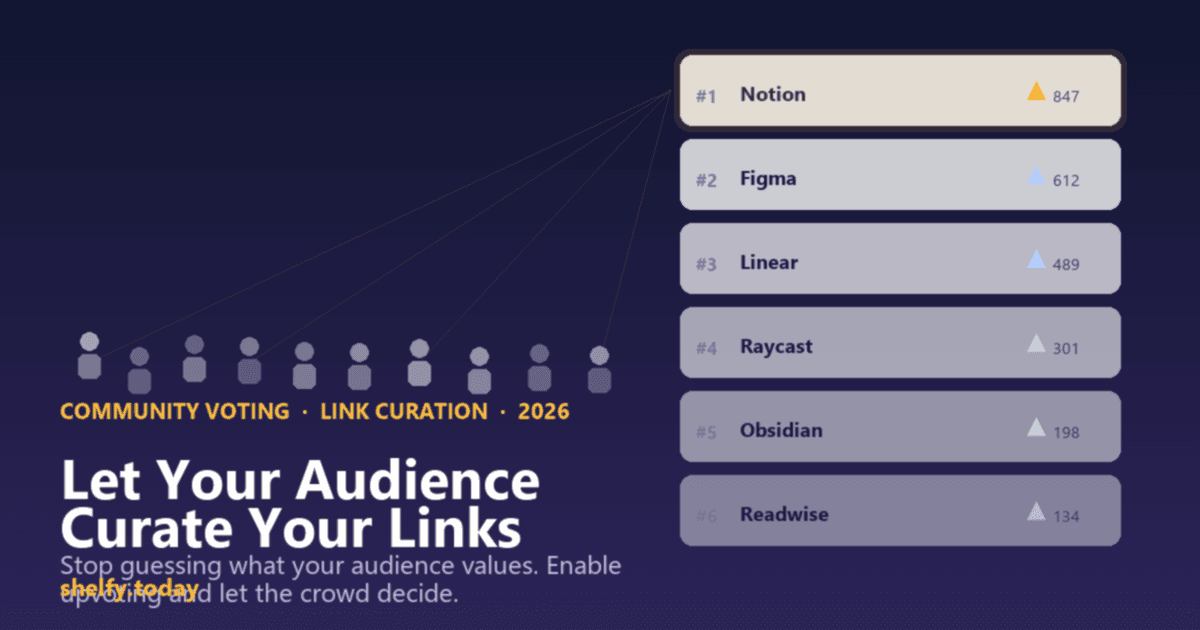
When you enable voting on a shared link collection, visitors can upvote links they find valuable. The most-voted links rise to the top. The collection becomes a living, crowd-ranked resource -- not a static list you arranged once and forgot.
Here's what this changes across different use cases.
For creators with a link-in-bio. You share a collection of resources with your audience -- tools you recommend, articles worth reading, products you use. Instead of guessing which resources your followers value most, you let them tell you. The top-voted links become a signal you can use everywhere else: in your content strategy, in your sponsorship pitches, in your product development. "My audience voted this their favorite tool" is a stronger proof point than "this link got the most clicks."
For team resource pages. You build an internal collection of tools, documentation, and references for your team. New hires use it during onboarding. Instead of guessing which resources are most helpful for new team members, the team votes. The onboarding experience improves with every new person who uses it and contributes a vote. The resources that actually help people surface. The ones that look important but aren't useful fade.
For course creators and educators. You share a supplementary reading list with students. They vote on which resources were most helpful. Next semester, you know exactly which readings to keep, which to drop, and which to make required instead of optional. Your curriculum improves automatically based on student signal.
For community builders. You curate a resource hub for your community -- tools, guides, templates, articles. Members vote. The resource hub becomes the community's collective knowledge base, not just your personal recommendations. Members feel ownership because they shaped it. Engagement increases because they have a reason to come back -- to see what's new and vote on it.
For content marketers. You share a competitor analysis page, an industry tools page, or a curated news feed with your audience. Voting tells you what topics they care about most. That data feeds directly into your content calendar. You stop guessing what to write about and start writing about what your audience has explicitly told you they value.
The data advantage nobody talks about
Here's the part that makes community voting strategically interesting rather than just functionally nice: the data is yours.
When your audience votes on your link collection, you're building a proprietary dataset of audience preferences that no analytics tool can replicate. You know, with explicit signal rather than inferred behavior, what your audience values.
This creates three advantages.
Sponsorship and partnership leverage. "My audience of 50,000 voted this tool their number one recommended resource" is dramatically more persuasive to potential sponsors than "this link got the most clicks." Votes are intentional endorsements. Clicks are not.
Content strategy signal. If your audience consistently upvotes links about a specific topic (say, AI tools for writing), that's a direct signal to create more content about AI writing tools. You're not inferring interest from search data or social engagement. You're seeing explicit preference.
Product development insights. If you're building a product and your audience has a curated collection of competitor tools, the voting pattern shows you exactly which features and approaches they value in existing solutions. It's lightweight market research that runs passively on your resource page.
The objections (and why they're wrong)
"My audience is too small for voting to work."
Voting is valuable even with small audiences. Ten votes is enough signal to differentiate your top resources from your bottom ones. You don't need thousands of votes for the ranking to be useful -- you need enough to separate signal from noise, and that threshold is lower than people think.
"People will just vote for the first thing on the list."
Position bias is real, which is why the initial arrangement matters. But over time, as the collection grows and people return, genuine quality overcomes initial position. This is the same objection people raised about Product Hunt, and in practice the best products still rise even if they launch at an awkward time.
More importantly: even with position bias, voted rankings are still more accurate than your guess. A biased crowd signal beats an unbiased sample of one (you).
"I want to control what's on top."
Then don't enable voting. But understand what you're giving up: the knowledge of what your audience actually values, the engagement benefit of giving them agency, and the self-improving nature of a crowd-ranked resource. You can always pin specific links to the top and let voting rank everything below them -- it's not all-or-nothing.
"What about gaming? People will vote for their own links."
Rate limiting, authentication, and anonymous voting controls handle this at the scale most creators operate at. You're not running a national election -- you're ranking a resource list. The bar for sufficient integrity is lower than you think, and the cost of imperfect rankings is trivially low compared to the cost of no signal at all.
Why nobody has built this (until now)
The link-in-bio market has been focused on making pages prettier, not smarter. Linktree, Beacons, Shorby, Bio.link: they compete on themes, widgets, analytics dashboards, and monetization integrations. They're all answering the question "how do I make my link page look better?"
Nobody asked "how do I make my link page get better over time without me touching it?"
That's the question community voting answers. Your page improves passively. Your audience tells you what matters. Your curation gets better every day without you doing any work.
Shelfy built this because we think the static, hand-arranged link page is a relic of 2016. The internet has had upvoting for twenty years. It's time your resource pages caught up.
How to get started
If you want to try this, the setup is simple.
Step 1: Create a collection on Shelfy. Add the links you want to share -- tools you recommend, resources for your audience, references for your team. Organize them into categories.
Step 2: Enable community voting. One toggle. When it's on, visitors see an upvote button next to each link.
Step 3: Share the collection URL. Put it in your bio. Send it to your team. Share it with your community. Wherever you'd normally share a static link page, share this instead.
Step 4: Watch the signal. Within a week of sharing, you'll have enough votes to see a pattern. The links your audience values most will have surfaced. The ones you thought were important but aren't will be lower.
Step 5: Use the signal. Reorder your collection based on votes. Create content about the topics that got the most votes. Reach out to the makers of the tools your audience loves. Pitch sponsors with voting data instead of click data.
The whole thing is free. No paid tier to unlock voting. No per-vote pricing. No limits on voters.
The bigger picture
The link-in-bio market is approaching a billion-dollar category, and the entire space is still operating on a model where one person decides what thousands of people see. Curation has been a solo activity since the first Linktree page was created in 2016.
Community voting changes that model. Curation becomes collaborative. Your audience doesn't just consume your resource page -- they shape it. The result is a page that's more useful, more trusted, and more engaging than anything you could build alone.
Your audience knows what they value. Let them tell you.
Related Reading
Shelfy is the only link management tool with built-in community voting. Create organized collections, enable upvoting, and let your audience surface what matters most -- all free, forever. Start at shelfy.today.